Spotlight On: Team members publications
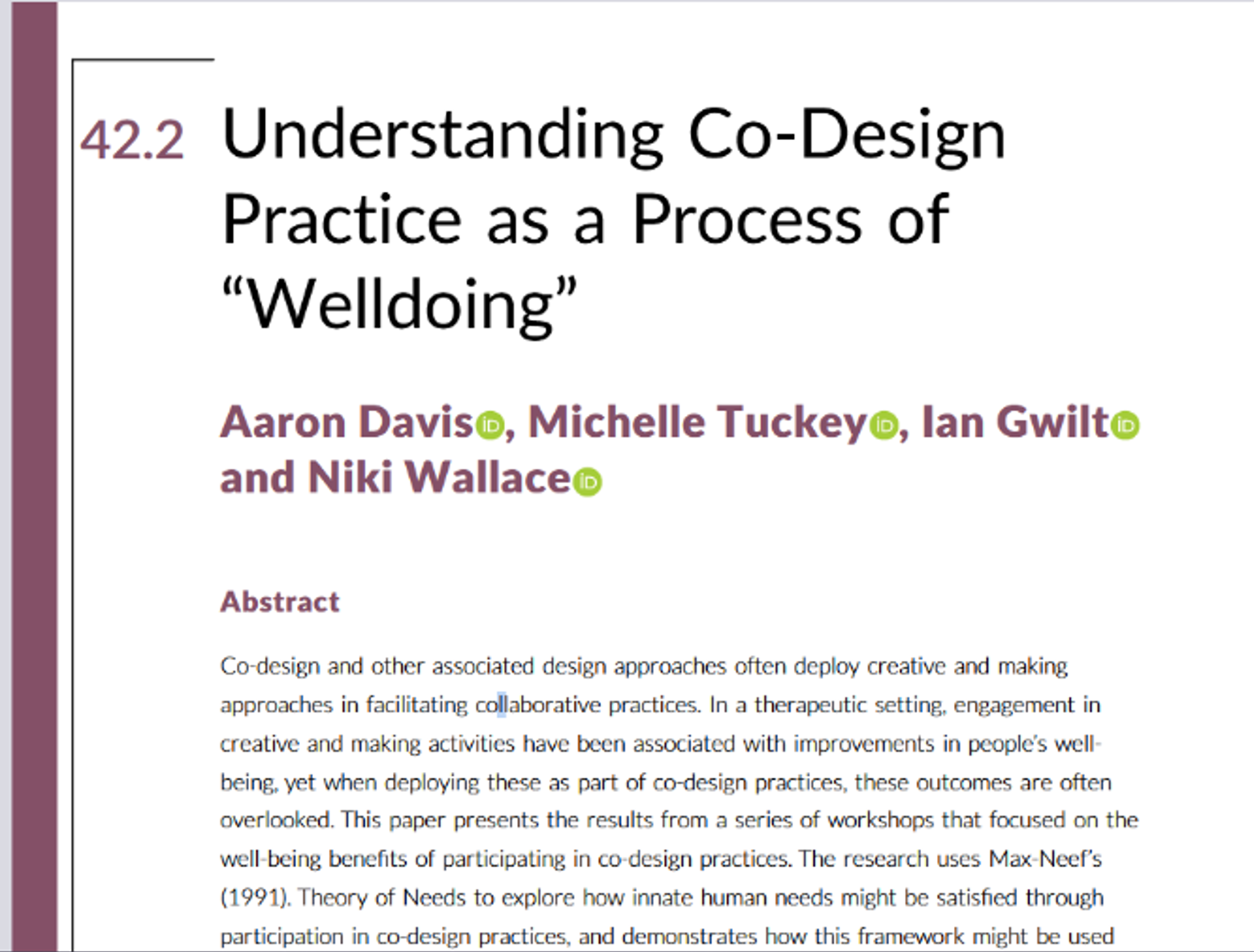
Throughout the project we will be featuring summaries of publications from our BRIDGES at Work team members which have provided foundational knowledge for our current project. This week, we take a look at a publication from team members Aaron Davis and Michelle Tuckey.
The full paper, entitled ‘Understanding Co‐Design Practice as a Process of “Welldoing.”’, can be accessed here:
https://doi.org/10.1111/jade.12459
Designing and demonstrating ways of working that enhance wellbeing
Co-design and other forms of participatory intervention often focus on the impact that the engagement with participants has on shaping project outcomes. But, there are other significant outcomes that can come from participating in (well designed and facilitated) co-design processes. This paper presents a framework that proposes evaluating the quality of co-design and participatory processes through the lens of ‘welldoing’, that is, the impact participation can have on someone’s wellbeing.
What we did
We worked with 27 co-design practitioners from around the world to document the types of wellbeing benefits they had observed in their practices, and summarised these against Max-Neef’s framework of fundamental human needs and satisfiers. Workshop participants identified examples of needs at all levels of Max-Neef’s framework being satisfied through participation in co-design, giving us a strong foundation to suggest ‘welldoing’ as a concept for the evaluation of, and, critically also the planning of, co-design and other participatory processes.
Why this matters
By reframing the purpose of co-design and other participatory workshops to consider the impact of participation on those who are part of the process, we can place value on people’s experience rather than only caring about what is produced. Initially, we focused on how this enabled better planning and evaluation, but as we have continued to roll this process out, we have found this a useful tool for understanding how the process of participation itself can become a critical part of an intervention.
Relevance to BRIDGES at Work
This framework is enabling us to centre the idea that participation is an important part of the intervention, rather than simply a step toward the intervention, and to develop processes that prioritise and value the experience of participants over the extraction of ideas and information.