Spotlight On: Team member publications
Throughout the project we will be featuring summaries of publications from our BRIDGES at Work team members which have provided foundational knowledge for our current project. This week, we take a look at a seminal publication from team members Michelle Tuckey and Yiqiong Li.
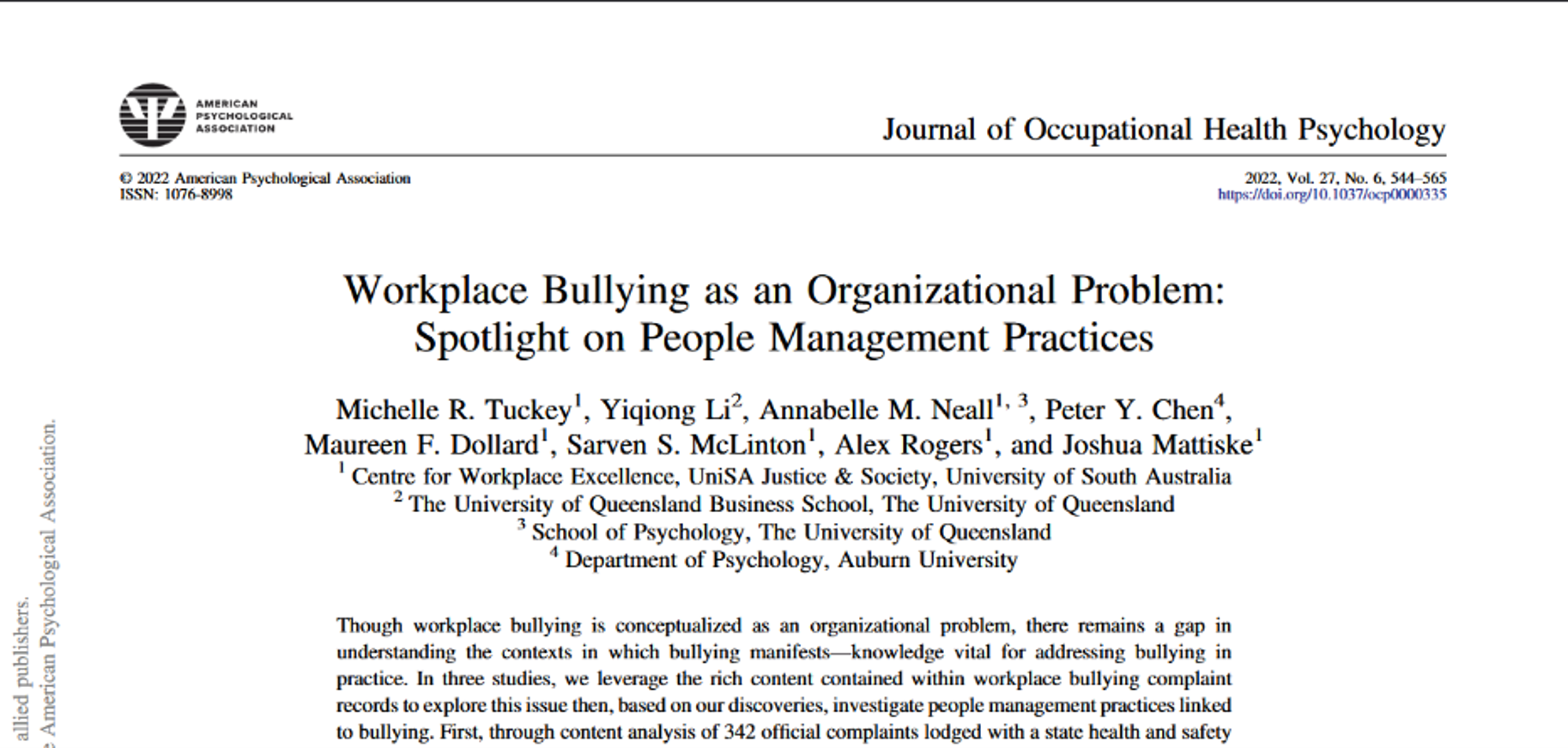
The full paper, entitled ‘Workplace Bullying as an Organizational Problem: Spotlight On People Management Practices’, can be accessed here:
Understanding bullying as an organisational problem
Bullying is more than difficult people or personality clashes. It's an organisational problem that emerges from systematic errors in everyday people management: routine ways in which work is coordinated, performance is managed, and relationships are shaped every day. When those practices are ineffective or unreasonable, the risk of bullying rises.
What we did
Across three studies we analysed 342 deidentified formal bullying complaints, interviewed frontline workers and managers, and validated findings in 25 hospital teams. From these studies, we identified the risk contexts for workplace bullying - recurring organisational patterns where people management practices can either prevent or enable bullying beahviour.
Why this matters
At the individual level, more effective people management across the risk contexts predicts lower exposure to bullying, beyond the most common, established bullying risk factors (e.g., role clarity, workload). At the team level, shared perceptions of the risk contexts among team members predict lower bullying exposure, beyond psychosocial safety climate. In practice, the risk contexts offer a focal point to “design out” bullying through collaboratively improving people management where it matters most. We had success doing this in our intervention studies that followed.
Relevance to BRIDGES at Work
The risk contexts idea is now guiding our approach the prevention of workplace sexual harassment. We are identifying a new set of risk contexts, some similiar to bullying but several unique to this form of gendered violence. These sexual harassment risk context will then become the focal point for a real-world intervention study, in the next stage of the project.